The Patient and Caretakers Section
Last updated Wednesday, August 31st, 2011
Electrocardiographic Features in Andersen-Tawil Syndrome
Patients With KCNJ2 Mutations
Characteristic T-U–Wave Patterns Predict the KCNJ2 Genotype
Li Zhang, MD; D. Woodrow Benson, MD, PhD; Martin Tristani-Firouzi, MD; Louis J. Ptacek, MD;
Rabi Tawil, MD; Peter J. Schwartz, MD; Alfred L. George, MD; Minoru Horie, MD, PhD;
Gregor Andelfinger, MD; Gregory L. Snow, PhD; Ying-Hui Fu, PhD;
Michael J. Ackerman, MD, PhD; G. Michael Vincent, MD
Last updated Sunday, August 28th, 2011
Do you suspect that you might have periodic paralysis? The periodic paralyses are a rare group of disorders and there are many conditions which cause an imbalance in serum potassium. So how does the doctor tell the difference between paralysis or weakness caused by an ion channelopathy and any of the other numerous disorders, conditions and reactions which might produce the same symptoms?
Last updated Friday, August 26th, 2011
In 2009 Professor Dr. Frank Lehmann-Horn of Ulm University, Ulm Germany, gave a presentation on managing hypokalemic periodic paralysis at the Periodic Paralysis Association's conference held in Orlando Florida. This presentation contained so much valuable information in such a compact and understandable format that we asked Dr. Lehmann-Horn for his permission to include it on our website, for the benefit of physicians and patients.
Last updated Sunday, August 21st, 2011
Hospital Management Guidelines for Thyrotoxic Periodic Paralysis Patients
Patient's Name:
Birthdate: ________Height: _______Weight: _______
Address:
Primary Physician:
Emergency contact: Your emergency contact should be someone who can speak for you when you cannot advocate for yourself.
Name: Relationship:
home phone# cell # FAX:
Last updated Saturday, August 20th, 2011
Last updated Friday, August 12th, 2011
First Actions:
-
Respiratory and cardiac arrest are possible.
-
Call for Cardiac Monitoring/EKG
-
Draw electrolytes to determine serum K+
-
Provide 02 as thimble may not reflect 02 saturation due to cardiac dilitation
-
Lie patient in coma position to avoid aspiration.

Last updated Sunday, August 7th, 2011
Provided by Frank Lehmann-Horn MD, PhD
From
Lehmann-Horn F, Rüdel R, Jurkat-Rott K. Chapter 46: Nondystrophic myotonias and periodic paralyses. In: Myology, edited by AG Engel, C Franzini-Armstrong. McGraw-Hill, New York, 3rd edition, 2004, pp. 1257-1300.
and
Klingler W, Lehmann-Horn, Jurkat-Rott K. Complications of anesthesia in neuromuscular disorders. Neuromuscular Disord, 15:195-206, 2005.
Last updated Saturday, August 6th, 2011
There are times when a member says just the right thing, producing a post which is simply too good to let slide into obscurity. This is one of those posts;
---
Hi "A",
Last updated Saturday, August 6th, 2011
A True Endocrine Emergency
Patients with Thyrotoxic Hypokalemic Periodic Paralysis typically present at the ER with an acute episode of paralysis involving the muscles of the extremities and limb girdles. The lower limbs are more frequently and severely involved than the upper. Weakness may be asymmetrical. Proximal strength is more severely impaired than distal strength. Respiratory and cardiac arrest are possible. Lie patient in coma position to avoid aspiration.
Cardiac Signs
Last updated Saturday, August 6th, 2011
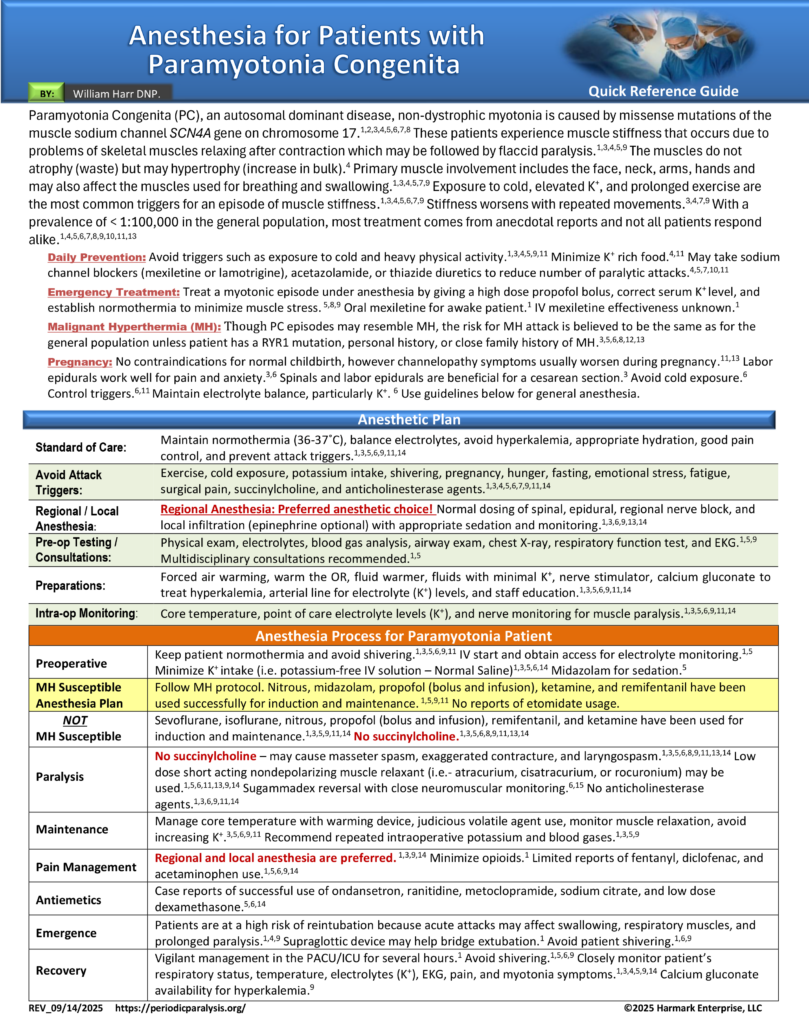
Hyperkalemic Periodic Paralysis and Paramyotonia Congenita can occur singly or in combination.
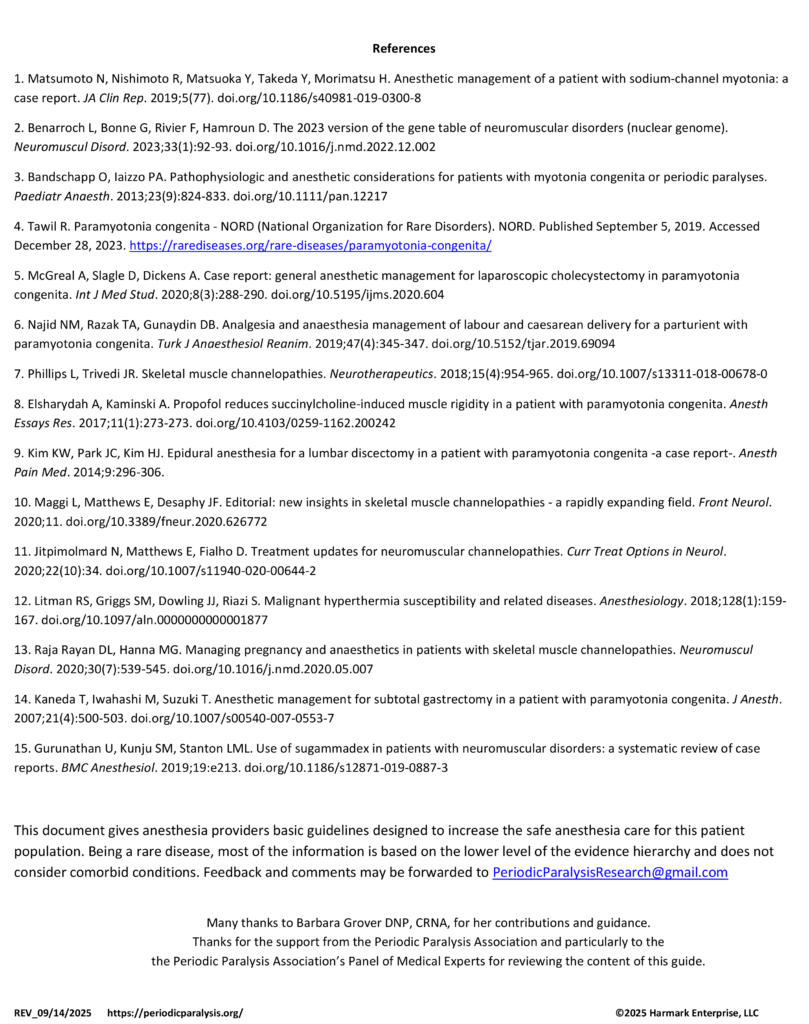
While most attacks of Hyperkalemic Periodic Paralysis are brief and do not require emergency intervention, occasionally the serum potassium level will be high enough to cause cardiac distress, or muscle stiffness may interfere with respiration. Attacks of weakness in Paramytonia Congenita are usually mild to moderate in severity, but myotonia of chest, diaphragm and throat muscles can be life-threatening under some circumstances.
Talk to your physician
Pages