The Patient and Caretakers Section
Last updated Friday, July 1st, 2011
When evaluating patients for periodic paralysis it is vital to obtain accurate results from blood draws. Because potassium levels which vary only a fraction of a point may be enough to trigger weakness in some patients, the lab may need to be made aware of specialized procedures which should ideally be used to obtain samples for K+ evaluation.
From "A Manual of Laboratory Diagnostic Tests" by Frances Fischbach, Page 247-253.
Potassium (K+) Normal Values: 3.5-5.0 mmol/liter 4.0-4.7 mmol/liter (average)
Last updated Tuesday, June 28th, 2011
Clinical Signs
Hyperkalemic Periodic Paralysis is a genetically determined disorder which causes attacks of weakness and flaccid paralysis. Attacks last from 10 min to 1 hour, very rarely up to 1-2 days. Some patients experience only a few attacks over their lifetime, others have attacks every day. Diagnosis is suggested by attacks of weakness during which the patient's serum potassium is above 5.0 mmol/l or rises at least .5 of a mmol/l above their normal level when not in an attack.
Last updated Tuesday, June 28th, 2011
Hospital Management Guidelines for Hypokalemic Periodic Paralysis Patients
Patient's Name:
Birthdate: ________Height: _______Weight: _______
Address:
Primary Physician:
Emergency contact: Your emergency contact should be someone who can speak for you when you cannot advocate for yourself.
Name: Relationship:
home phone# cell # FAX:
Periodic Paralysis International provides this statement in order to make clear our firm commitment to privacy.
Periodic Paralysis International Website, the HKPP Listserv and associated forums subscribe to HONcode Principles, including principles of confidentiality. Confidentiality of data relating to patients and visitors to this website is respected.
Last updated Tuesday, June 28th, 2011
The Importance to Physicians of Support Groups for Rare Conditions
The Genetic Drift Vol. 8: Winter, 1992
Consumer Issues in Genetics Services
by Jack Dolcourt, M.D. Neonatologist
Last updated Monday, June 27th, 2011
Are Weakness and Fatigue Between Paralytic Attacks Symptoms of Periodic Paralysis?
Last updated Monday, June 27th, 2011
Parents of some children with Periodic Paralysis will need to work with the school to achieve a plan which will allow their child to reach their full potential. The information in this article reflects the experiences of children in US schools. We hope it will be helpful to parents, school administrators, teachers, school nurses and physicians as they work together.
Last updated Monday, June 27th, 2011
Life is a daily challenge for the child with periodic paralysis.
Periodic Paralysis poses unique problems for school-age youngsters. Because young PP patients usually look perfectly normal, and may even look extremely muscular and fit, it's hard for school staff to understand what a challenge daily life can be for them. But these children's strength may vary widely from day to day, even hour to hour, which is not just frustrating for teachers to cope with but extremely difficult for the child as well.
Last updated Monday, June 27th, 2011
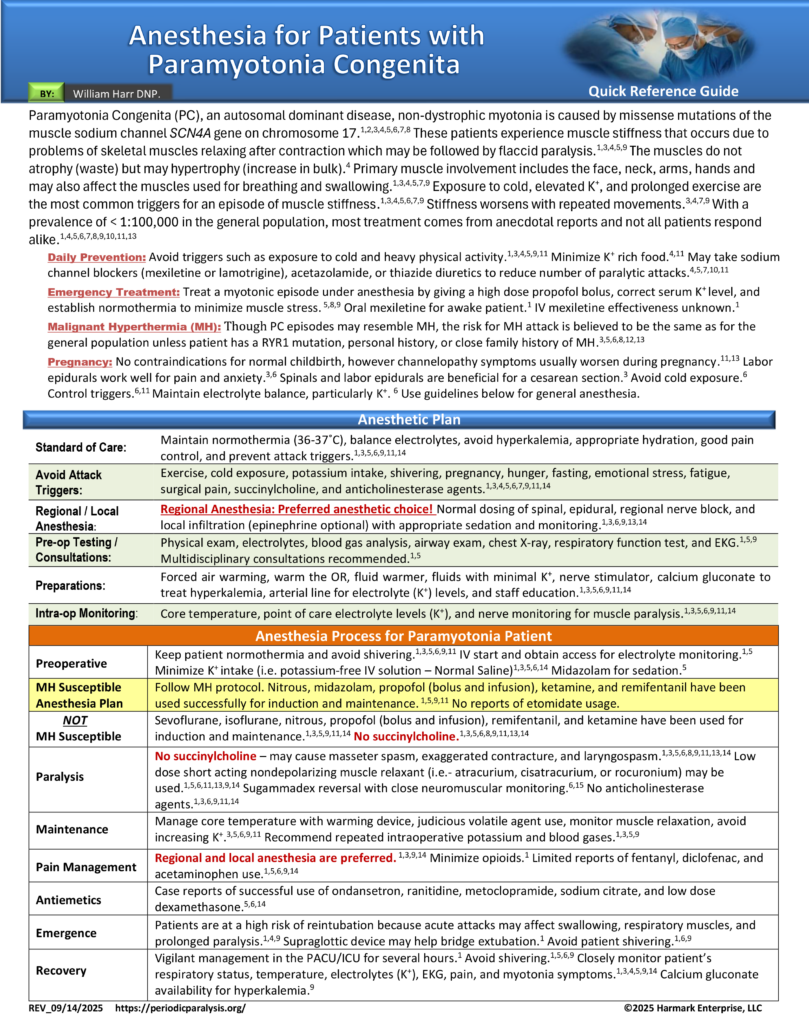
Patients with Sodium channel HyperKPP and PMC mutations are at increased risk of Malignant Hyperthermia;
Last updated Monday, June 27th, 2011
Periodic Paralysis Patients at Increased Risk of MH
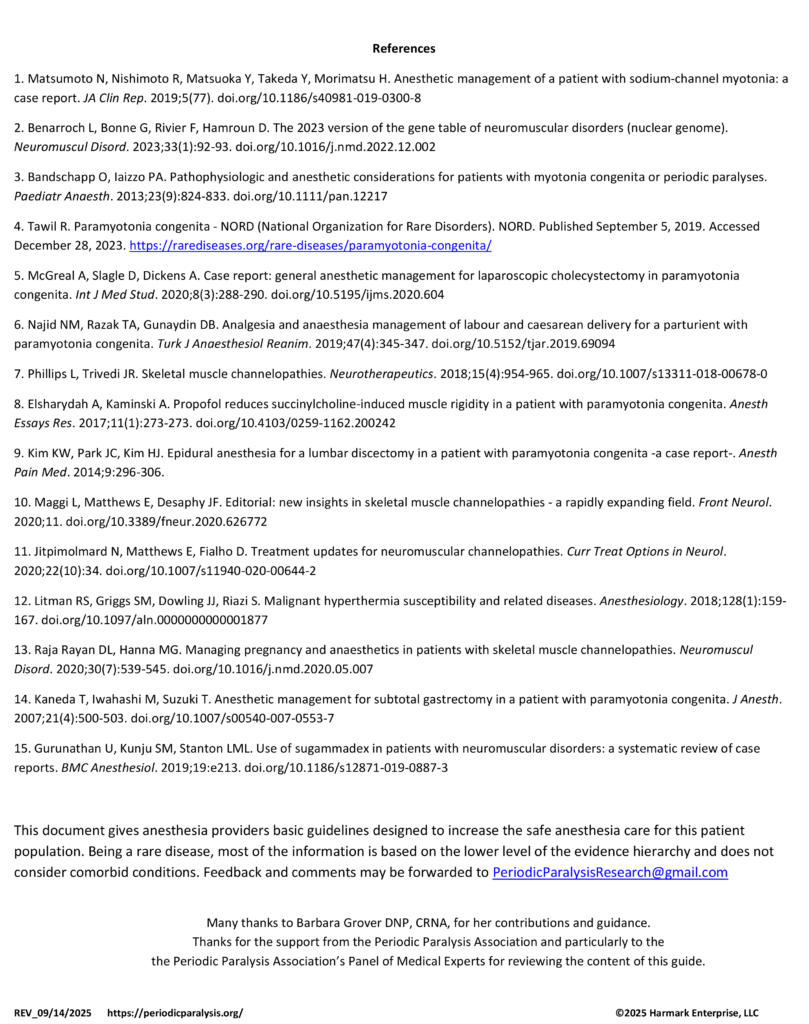
Patients with Hyperkalemic periodic paralysis and Paramyotonia Congenita are at increased risk for Malignant Hyperthermia (MH) during surgery.
Pages